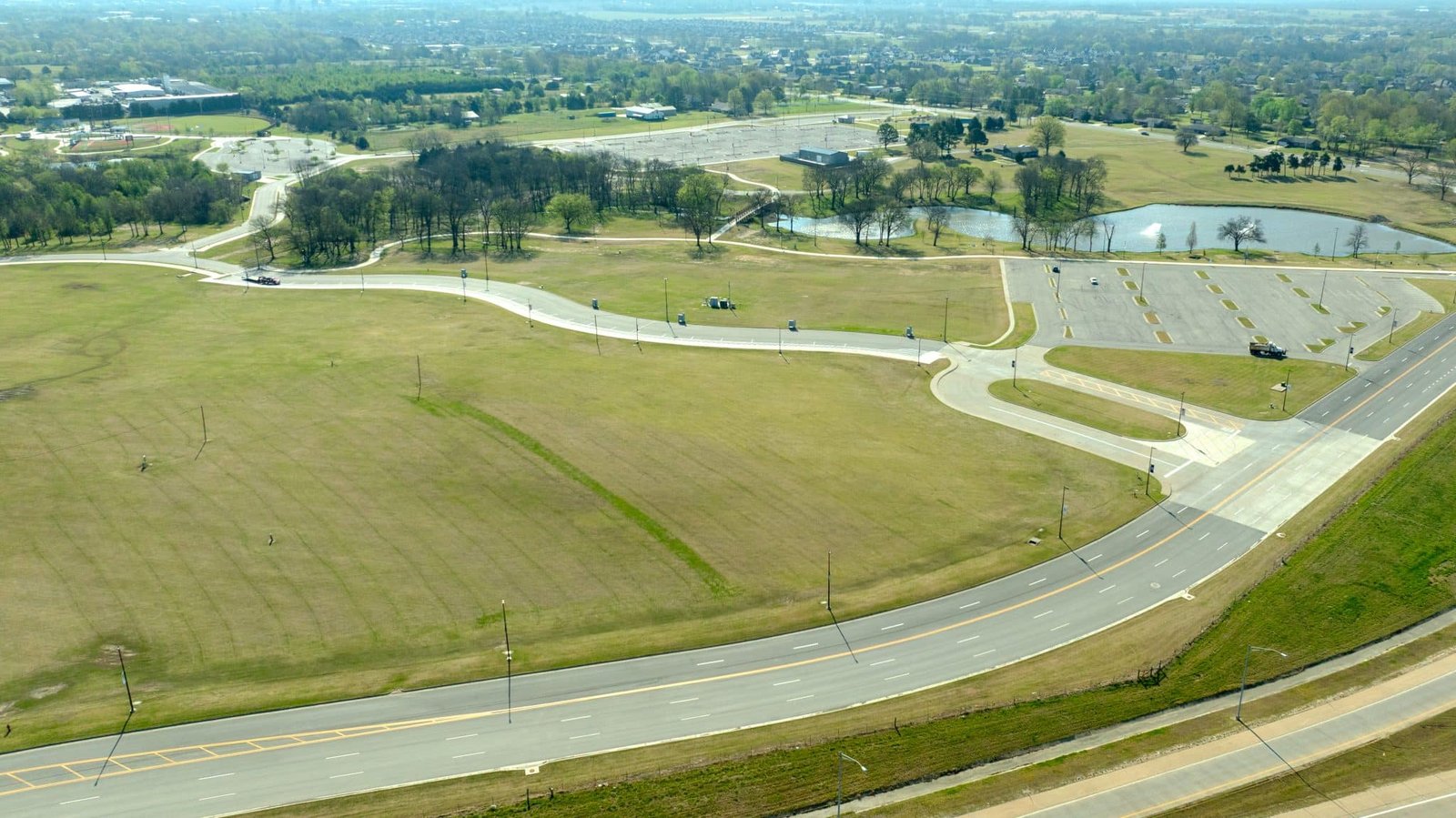
An amphitheater lot empties in under an hour, and a builder has to design the roads, paving and lighting for that hour rather than for the average day. Near Broken Arrow Events Park, at the Creek Turnpike and 101st Street, we build the supporting work that lets a large venue function: access roads, parking fields, drainage, utilities, pedestrian crossings and the support buildings around them.
KRMG reported on April 1, 2026 that the Events Park reopened after a closure since May 2024 for infrastructure work tied to the 12,500-seat Sunset Amphitheater Broken Arrow, which was expected to open in fall 2026. The park work included roadway upgrades, a new Oklahoma Turnpike Authority onramp accessible from inside the park, better parking and a pedestrian bridge. That list is a useful summary of what venues need from the ground up: a way in, a way out, a place to park and a safe way to walk.
We do not claim a role in the amphitheater project. We do build the kinds of work that sit around it, and we explain below how we plan them, how we coordinate with public agencies, and what owners of nearby sites should think about as the venue draws crowds, with the wider Broken Arrow market as the backdrop.
Paving, concrete and utilities that carry a crowd
Venue work depends on earthwork and paving. Our trade partners grade the lots, install storm sewer and inlets, place base and asphalt or concrete, and stripe parking for accessibility and flow. Traffic loads for a venue are heavier than for an office parking lot, because buses, trucks and service vehicles share the pavement with cars, and event staging can concentrate loads in unusual places. We design sections with the engineer for the worst expected load.
Concrete work includes sidewalks, curb ramps, plazas, pedestrian bridge approaches and equipment pads. Our parking lot construction work builds lots with the slopes, drains and sequences that let a field handle thousands of vehicles. For site utilities, our site development and utilities work extends water, sewer, electric and lighting conduit to where they are needed.
Buildings around a venue
A venue draws businesses to its edges: restaurants, hotels, fuel stops, offices and ticketing or storage buildings. Each has a rhythm tied to events. A restaurant must handle a rush before a show. A hotel must handle check-ins before and after. A storage building may need to be accessible to trucks at odd hours. We design and build with those rhythms in mind.
We also build the temporary and semi-permanent structures venues need, such as concession buildings, restroom blocks, gate houses and maintenance shops. These buildings must be tough, easy to clean and quick to build. Pre-engineered metal buildings with concrete slabs are often the economical solution, and our pre-engineered metal building team can deliver them on a schedule that matches the venue's calendar.
Public improvements and agency coordination
A City of Broken Arrow council recap dated September 4, 2024 reports that the council approved buying the property across from the Events Park entrance on 101st Street for $225,000 and improvements costing $2.8 million, including widening 101st Street at the park entrance, traffic control, and electrical and asphalt installations. When the public sector invests in an entrance like that, adjoining owners should expect new traffic patterns, new signals or lane changes, and new rules about driveway locations.
We contact the city, the state and the turnpike authority early on any adjoining project, to learn where the public improvements will sit, when they will be built and what access the private site will have. The state minimum for commercial buildings is the 2024 International Building Code as amended, effective September 14, 2026, and assembly occupancies bring additional life safety requirements for exits, occupant load and emergency lighting.
Crowd safety starts in the design
Large gatherings put people close together and in the dark. A good design provides clear exits, wide walkways, lighting with no dark gaps, handrails at grade changes and barriers that separate pedestrians from vehicles. The pedestrian bridge at the park is an example of a feature that moves people away from vehicle conflicts, and owners nearby can borrow the principle for their own sites.
During construction, our safety practices focus on keeping the public away from work areas. When an event is scheduled, we secure the site, remove loose materials and open travel lanes. If the park is hosting an event while work continues nearby, we follow the venue's rules and coordinate with its operations staff. Our commissioning and closeout process verifies lighting, emergency power and life safety systems before a facility is opened to guests.
Working to an opening date and an event calendar
Entertainment projects often have fixed opening dates tied to ticket sales, and the schedule has little room for slip. We build the plan around the date, identify the critical path, front-load the long-lead items and agree on how we will report progress. We also separate the work into stages so portions of the site can be used if the full scope is not complete.
Weather is the other variable. Paving and concrete need dry conditions, and a wet fall can set a project back. We keep paving crews flexible, watch the forecast and build float into the earthwork stage. After the opening, we are available for punch list and warranty work at times that do not interfere with events.
What the investment signals to nearby owners
The Oklahoma Department of Commerce announced on July 16, 2024 up to $39.5 million in state matching funds under the Enterprise Zone Incentive Leverage Act for Sunset at Broken Arrow, a 12,500-seat amphitheater near Events Park in Wagoner County, with a committed $71.5 million capital investment and about 600 direct and indirect jobs. We read that as a signal of confidence in the corridor rather than a promise for any one neighbor.
Owners of nearby parcels should ask how a venue's traffic, noise and lighting will affect their use. A restaurant or hotel may benefit; a quiet professional office may not. Our hospitality group and Coweta pages describe other places in the metro where large hospitality and entertainment investment is shaping construction.
Tell us what you plan near the Events Park
Send the parcel, the use and your target date. We will review access and utilities with the city and state, and give you a budget and schedule that fit the event calendar.
Common Questions
What pavement section is right for a venue parking lot?
It depends on the traffic mix and the subgrade. Buses and service trucks need thicker sections than cars. Your engineer will set the design, and we recommend a geotechnical investigation before pricing.
Can adjoining owners connect to the new park roads?
Possibly, but access is controlled by the city and the state. We help you request permits and design driveways that meet spacing and sight distance rules.
How should a restaurant near an event venue plan its kitchen?
Plan for peaks. Sizing of cooking lines, coolers, grease interceptors and seating should reflect short, intense rushes. We help owners test the layout against expected event surges.
Do assembly buildings have special code requirements?
Yes. Occupant load, exits, emergency lighting, fire alarms and accessibility are more demanding for assembly occupancies. We confirm requirements with the plan reviewer before design is final.
How do you build near an operating venue?
We coordinate with venue operations, secure the site on event days, maintain travel lanes and schedule noisy work outside show hours.