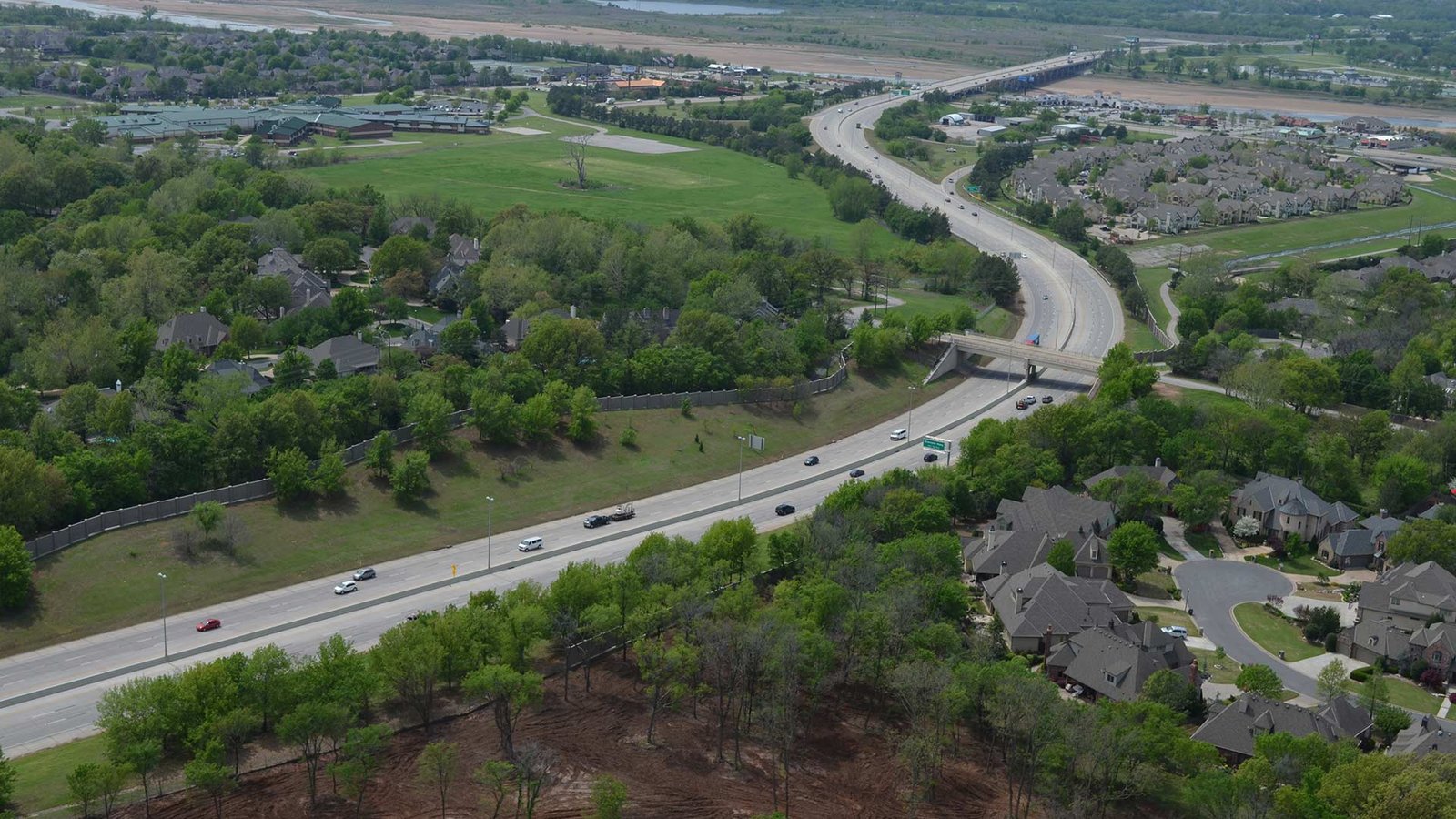
Haul routes decide schedules on the Creek Turnpike, and the best builders along SH-364 plan their truck traffic before they plan their foundations. A concrete pour that depends on 40 mixer trucks arriving in sequence is a different job when the nearest approach road is down to one lane. We build retail, industrial and commercial projects near the turnpike with a standing habit of checking current traffic advisories every week, because conditions on this corridor are changing.
The Oklahoma Turnpike Authority's advisory dated November 2, 2026 reports that Creek Turnpike traffic has moved onto the new Haikey Creek bridge and is reduced to one lane each way between US-64 and E. 111th Street, mile markers 14 to 15. It adds that the eastbound on-ramp from 96th Street is closed through fall 2026 and that delays are expected through summer 2027. Anyone planning deliveries on that stretch has to accept those facts and build them into the delivery plan.
We do not predict the turnpike authority's schedule, and conditions may have changed by the time you read this. What we do is keep an alternate route for every heavy delivery, share the plan with the drivers and the owner, and keep a couple of weeks of float in any schedule that depends on a single approach.
A $72 million bridge project and what it means for neighbors
Local reporting in July 2025 described a $72 million Oklahoma Turnpike Authority project on the Haikey Creek Bridges, which were built in 2001 and carry more than 33,000 vehicles a day. The work includes replacing more than 480 concrete beams and was expected to run until summer 2027. For a property owner, this is both an inconvenience and an indicator: a corridor that receives that much public repair spending is a corridor the state expects to keep using.
A second item on the November advisory is a westbound shoulder closure on SH-364 between Aspen Avenue and Elm Place, for retaining wall repairs along the Liberty Trail, estimated to finish in mid-December 2026. These closures show how shoulders, ramps and trails all share a narrow right-of-way, and why sites next to them need careful survey and setback checks.
Sequencing around lane closures
On a parcel with only one practical entrance, we plan deliveries in blocks. Large pours, steel erection and roof deliveries are scheduled for the days when approach roads are least constrained, while smaller deliveries use side streets or an off-site staging yard. If an on-ramp is closed, the crew foreman and the drivers learn the detour a week ahead rather than finding it on the day.
We also build float into the schedule at points where a delayed delivery would idle an entire crew, such as before a tilt-up panel lift or a slab pour. Owners who insist on a date that assumes perfect traffic usually end up paying for overtime later. We prefer to show a realistic date and keep it.
Retail and commercial pads near the turnpike
Hackberry Market sits at the northeast corner of Aspen Avenue just off the Creek Turnpike and, according to local reporting in April 2026, is expected to open in late 2026 with a home improvement store, a craft retailer, an off-price apparel store and a department-style discounter. Large tenants of that kind encourage nearby pad sites for restaurants, banks and service businesses, which is the kind of work we build with our retail shopping center construction team.
Pad sites near a new large-format center carry unique demands: shared access drives, cross-easements, drive-through stacking and signage rules. We map those against the city's requirements and the developer's design guidelines so a bank, a restaurant and a clinic can all be built without conflicts at the property line. For retail chains rolling out prototype stores, we maintain a repeatable checklist that adapts to each lot.
Working next to high-speed traffic
Construction beside a turnpike requires attention to dust, debris and glare. We keep construction entrances clean, use wheel washes where needed and keep material stockpiles away from the right-of-way. Cranes are positioned so a boom cannot swing into the roadway, and we coordinate any lift near the corridor with the authority.
Workers are also exposed to traffic noise, shifting haul-truck patterns and the pressure of an owner's date. We hold short daily meetings, assign a competent person to every excavation and cover fall protection, trench safety and equipment spotters. These are simple practices, but they are what keep a tightly staged site safe.
Setbacks, grades and neighbors on the corridor
A turnpike corridor puts a hard edge on a site. Grades drop toward drainage structures, fence lines mark limits you cannot build over, and utility easements run where you would like a building. Before design starts we ask for a boundary and topographic survey, check recorded easements, and mark the buildable area, so the architect works inside real limits and not guessed ones.
Residential and school neighbors also matter. Noise, lighting and truck routes that are tolerable beside a highway can be a problem one block inside the neighborhood. We write construction hours into our plan, point work lights downward and keep haul trucks on arterials, which prevents complaints from reaching the city and slowing your permit or inspection requests.
Parking, drainage and truck courts
Sites along a turnpike usually have to handle stormwater from a sizeable impervious area. Detention ponds, inlets and outfall protection must be built early, since they also serve as sediment control. Our stormwater and drainage work is set up so the basin is dug, protected and functional before foundations go in.
For industrial and distribution users, truck courts and dock aprons require concrete thick enough for loaded trailers, with joints placed to avoid landing-gear damage. For retail users, parking lot construction focuses on drainage, striping, lighting and access control. We design both with the long-term maintenance cost in mind.
Plan around the corridor
Send the parcel address and your target opening. We will review access, current advisories and permit needs, then give you a delivery plan and schedule that holds up on this corridor.
Common Questions
Should I wait until the bridge work is finished to build?
Not necessarily. Many sites have alternate approaches, and construction traffic is a small share of the volume on a road carrying more than 33,000 vehicles a day. We review your access, plan haul routes and tell you honestly whether waiting would save money or simply delay your opening.
Where can I check current turnpike conditions?
The Oklahoma Turnpike Authority posts traffic advisories on its newsroom page, and we review them before any heavy delivery week. Conditions change, so we suggest owners and subcontractors do the same.
Does a site beside the turnpike need special approvals?
Possibly, if you need a new driveway on a state highway, work in the right-of-way or discharge to a turnpike drainage structure. We identify those touchpoints in the first week and prepare the permit applications in parallel with building plans.
Can you compare Creek Turnpike sites with Broken Arrow Expressway sites?
Yes. They differ in traffic patterns, tenants and approval paths. See our notes on the Broken Arrow Expressway corridor and on Creek 51 Business Park, then call us with the specific parcel.
How much float should a corridor schedule carry?
We usually hold one to two weeks ahead of milestones that need many trucks at once, such as foundations, slab pours and roof deliveries. The right number depends on how many approaches your site has and what the authority has announced. We would rather show you a firm date with float than a tight one that slips.