Fifty-six homes in Catoosa flooded in the Memorial Day storm of 1984 when Bird Creek rose, according to the National Weather Service. Nobody who builds in this metro treats that as ancient history. Creeks here respond quickly to heavy rain, and a new roof and a new parking lot both shed water faster than the pasture they replaced. Every commercial site we build has to send that extra water somewhere without making a neighbor's problem worse.
Stormwater is the part of site work that owners tend to underestimate on a budget and that inspectors never forget. A detention basin takes land that could have held parking. A storm sewer trench runs through the same corridor as water and sewer service. An outfall may need approval from a city, a county or a drainage district, and the review may take longer than the construction. We build drainage systems as a dedicated scope, and we sit down with the civil engineer early enough to influence the layout.
What follows is how we approach it for owners and developers in Broken Arrow, Jenks, Catoosa and the other communities around Tulsa.
Rivers, levees and creeks in this metro
The Arkansas River and its tributaries shape drainage thinking all over the Tulsa area. In Jenks, the Army Corps of Engineers built a levee around the city in 1948 after repeated floods from the Arkansas River and Polecat Creek, and a large release from Keystone Dam in 1986 led to an evacuation order, according to published histories. Those events are why local reviewers ask hard questions about downstream capacity, finished floor elevations and what happens when an inlet clogs during a storm.
Public projects are also reshaping drainage in our own area. The Elm Street widening in Jenks from 111th to 131st includes a new storm water system, and the planned widening of 23rd Street in Broken Arrow includes an enclosed storm sewer and a relocated waterline. Private sites tying into that infrastructure need to match its timing, and we watch public project schedules the way we watch our own.
Approvals before the first pipe
Most commercial sites need a drainage study, a stormwater pollution prevention plan for construction, and a municipal permit for any new connection to a public system. Detention facilities usually need a maintenance agreement recorded against the property, which matters to a lender and a future buyer. We read those documents with the owner before closing on land, because a recorded maintenance obligation is a long-term cost that does not appear on the site plan.
Oklahoma sets a statewide minimum building code, but drainage and site grading rules are largely local. A project in Tulsa, in Jenks and in Broken Arrow can face three different submittal formats and three different reviewers. Our preconstruction team keeps a running list of what each office asks for, and we route submittals to match, which shortens the review cycle that otherwise holds up permitting and entitlements.
Pipes, inlets, basins and outfalls
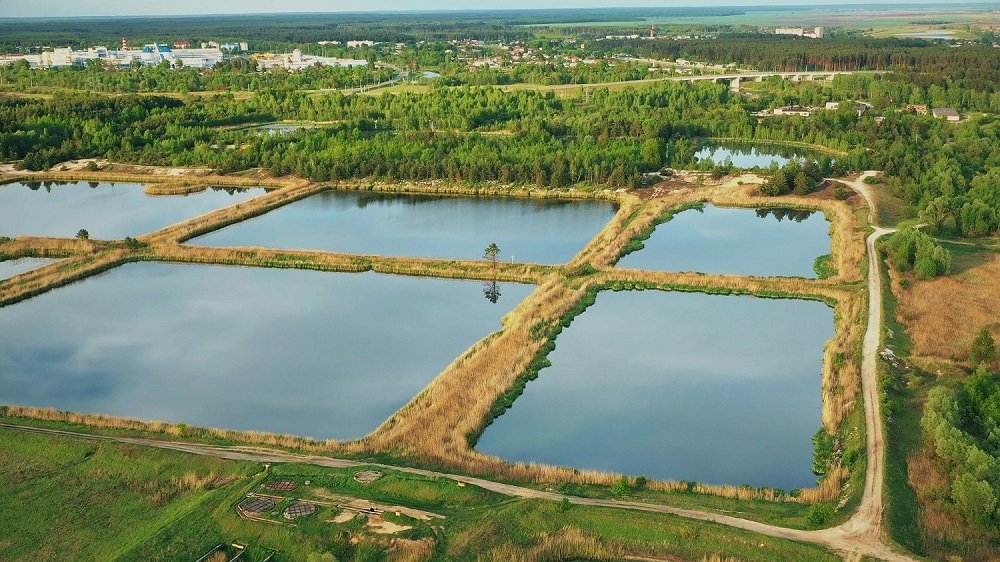
The work usually starts with the outfall and moves upstream, so water has somewhere to go on the day the first pipe is placed. We install reinforced concrete and plastic pipe in the sizes the engineer specifies, set inlets and manholes to grade, and build headwalls, riprap aprons and concrete flumes where flow needs to be controlled. Detention basins are excavated and shaped to the drawn volumes, with outlet structures, emergency spillways and stabilization built to the design.
The details decide whether a system performs. Bedding and backfill are compacted in lifts so pavement does not settle over a trench. Inlet tops are set to final pavement grade, not to the rough subgrade, which avoids ponding at the curb. Basins are seeded or matted and inspected after the first rains. When the project includes a large parking lot, we plan the surface slopes and the storm sewer together so the water has a clean path.
Why we keep the pipe crews close
Storm sewer work is wide open to coordination trouble. The pipe crew, the earthwork crew and the paving crew all depend on the same grades, and a few tenths of an inch off at an inlet can cause a puddle that lasts for years. We keep the layout, the pipe installation and the final grade checks under one supervisor so that the person responsible for the inlet elevations is also the person who walks the pavement afterward.
That coordination matters most on tight sites. A retail pad squeezed between an access road and an existing drainage easement leaves little room for a detention basin, and the answer is sometimes underground storage or a shared regional facility. We have the experience to price those alternatives, and we can help an owner decide whether the savings on land justify the premium on structure, especially for retail centers.
Fitting drainage into the critical path
Storm sewer and detention work should happen early, immediately after mass grading and before foundations or paving. A basin that is finished late forces everything else to protect itself with temporary controls. We ask for the drainage plan to be treated as a first-phase deliverable, and we price the early start as a cost that pays for itself in fewer erosion repairs and fewer inspector comments.
Weather, again, is the wild card. A site left open through a wet spring needs frequent inspections and a plan to pump or divert water. For public agency owners, including those building through the government and public sector procurement process, we document every rain event and every correction so the record is clean at closeout.
Plan the water first
If you are evaluating a parcel in the Tulsa metro, send us the drainage study or the plat. We will show you where the water goes, what it costs to manage it, and how it fits the construction schedule.
Common Questions
How big a detention basin will my site need?
That is set by the civil engineer based on the local drainage criteria, the size of the contributing area and the amount of new impervious surface. We cannot give a number without the study. What we can tell you is how much land a basin of a given volume will consume and whether underground storage is a realistic alternative.
Can I connect to an existing storm sewer instead of building a basin?
Sometimes, if the downstream system has capacity and the city or county agrees. Connection often requires a study and sometimes a fee in lieu of on-site detention. We check the options early, because the answer changes the site layout.
Who is responsible for maintaining the basin after construction?
Normally the property owner, under a recorded maintenance agreement. We provide a maintenance summary at closeout that lists the outlet structure, the inlet clean-out points and the inspection schedule, so the facility manager knows what to do.
What causes drainage failures on new commercial sites?
The common causes are inlet tops set too high, trench settlement, basins that were never stabilized, and downstream flow that was not considered. All of them can be avoided with careful survey control and inspections after the first heavy rain.
How does stormwater work affect the schedule?
It is usually an early-phase item that runs several weeks, depending on pipe length and weather. The bigger schedule effect comes from agency review of the plans and any off-site connection work.