Four ICU beds and fourteen progressive care beds opened on a new floor at the Broken Arrow hospital, an $8 million addition estimated to serve 1,500 patients a year. Behind that one sentence is a construction story: a live hospital with patients, visitors, deliveries and emergency traffic that could not stop for a contractor. Work like that is the hardest kind in our trade, and it is also the most common request we hear from healthcare systems, school districts, church campuses and property managers.
Phased construction on an occupied site means building, renovating or expanding while the people who use the place keep using it. It calls for physical separation, careful scheduling, control of noise, dust and vibration, and relentless communication. The cost of a mistake is not just rework. It can be an interrupted surgery, a lost class period, a closed store or a safety incident.
Here is how we plan the work, what the owner can expect, and where the difficulties usually appear.
Separating the work from the people
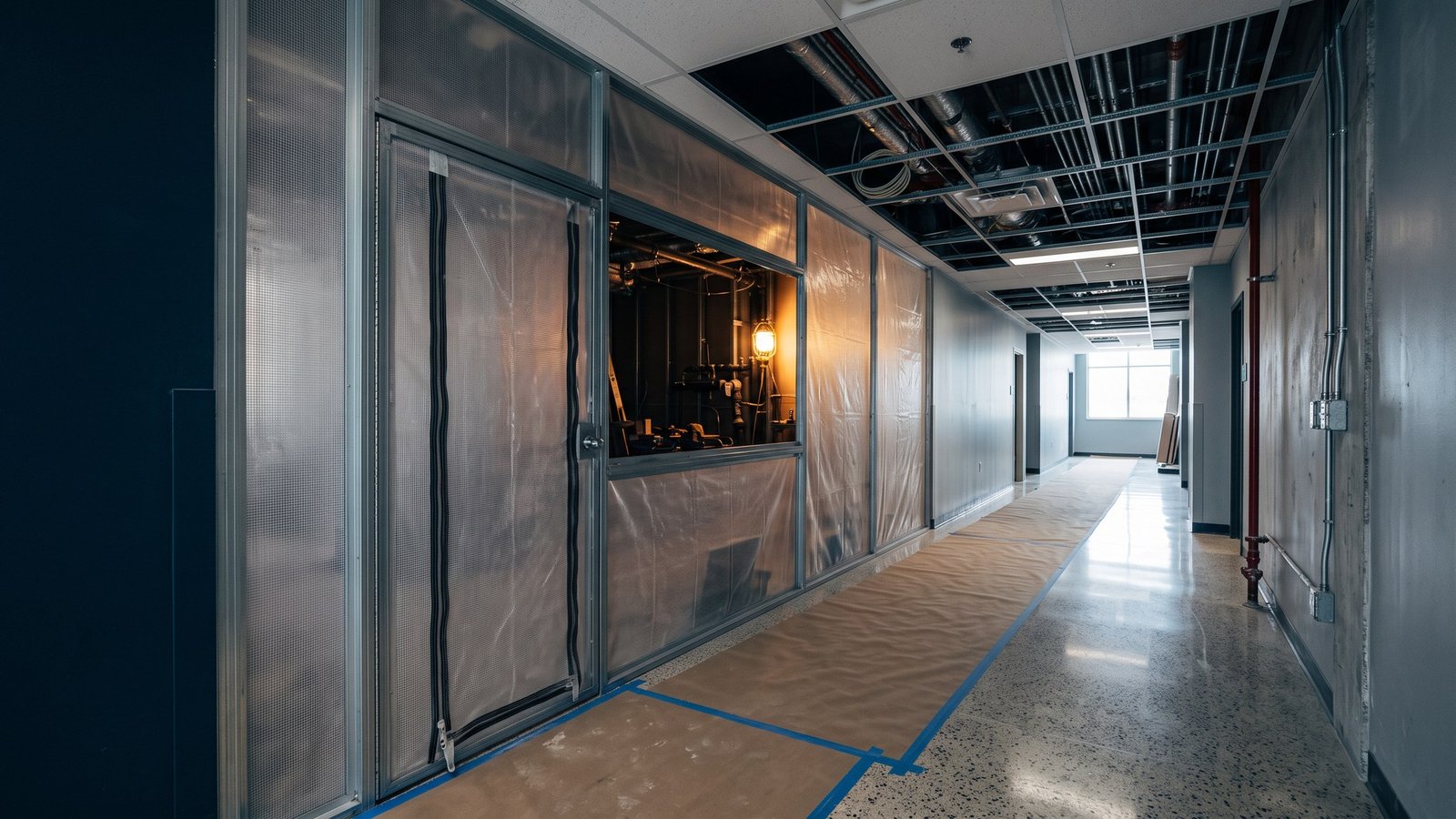
The first line of defense is physical. We build temporary walls, dust barriers, negative air machines where needed, protected corridors and separate construction entrances. In healthcare settings, the infection control risk assessment drives the barrier type, the ventilation approach and the cleaning protocol, and we work from the owner's infection prevention staff, not around them. In schools, we separate construction fencing from play areas and bus lanes, and we sign in every worker.
The second line is procedural. Hot work permits, lockout and tagout, ceiling access permits and utility shutdown requests all follow written procedures agreed in advance. Nobody opens a wall above an occupied room without the owner's approval and a plan to protect what is below. We brief every trade on these rules before they walk on site, and the superintendent enforces them daily.
Noise, vibration and shutdowns
Noisy work, such as demolition, coring, drilling and compaction, is scheduled when it will cause the least disturbance: evenings, weekends, school breaks or the hours before a clinic opens. Vibration-sensitive areas, such as imaging, labs and surgical suites, need monitoring and sometimes alternative methods. The owner's staff know where the sensitive spaces are, so we ask for a walk-through and a map before we plan.
Utility shutdowns deserve their own plan. A water shutoff, a power transfer, a fire alarm outage or a medical gas tie-in has to be coordinated with life safety measures such as a fire watch. We write a shutdown plan for each event, with the date, the duration, the affected areas, the backup and the rollback, and we keep the plan with the owner's operations team. A career-technology campus like Tulsa Tech's 53-acre site on West Florence Street, with programs in welding, CNC machining, diesel service and truck driver training, runs power-hungry shop equipment, so on an expansion there the equipment shutdowns would be among the first things we scheduled with the instructors.
Phasing plans that match how the owner operates
A phasing plan is more than a drawing with colored areas. It is a sequence that keeps each part of the facility working while another part is under construction, and it has to match the owner's calendar. A school calendar, a clinic's busy season, a retail holiday period and a church's Sunday service all affect when a phase can start and end. We build the sequence with the owner and then test it by walking through a typical day in each phase.
We also plan for contingencies, including what happens if a phase runs over. Backup space, temporary relocations and a defined decision point let the owner choose between pushing the work or delaying handover without scrambling. These plans are typical in renovation and adaptive reuse work and in tenant improvement projects where one tenant is moving out while another is moving in.
Weekends, breaks and the cutover
Many tasks can only happen when the building is empty or lightly used. The exact windows vary: a few hours on a Sunday morning, a summer break, a holiday weekend or an overnight. We plan critical cutovers with detailed run-of-show schedules that list each activity, who does it, how long it takes and when the decision to go or roll back is made. Pre-work, such as pre-pulling wire and pre-assembling equipment, shrinks the window itself.
Outdoor event spaces have similar constraints. The Rose District plaza in downtown Broken Arrow hosts farmers markets and ice skating under its covered pavilion, and a planned upgrade would roughly double that covered area. Building around a place that people use week after week means staging work between events, keeping paths open and finishing a phase before the next gathering. See also our work in the Rose District.
Where occupied-site phasing is most common
Hospitals and clinics are the best-known examples: the system behind the Broken Arrow hospital announced a $16 million expansion across its Broken Arrow and Owasso hospitals in 2021, with construction expected to finish in early 2023. Our healthcare and health system work follows the same infection control and shutdown protocols whatever the project size. The hospital district gives a sense of how many separate buildings and users can share a campus.
Schools and colleges are the second major group, with summer windows that are short and non-negotiable. The Northeastern State University Broken Arrow campus, with more than 60 classrooms and 12 science labs, began offering lower-division courses in spring 2026, and a campus like that has to keep classes running while it adds space. Our education work and our involvement with education institutions are built around that calendar. The education campuses around the city are examples of where we bring this approach.
Keep the doors open
Describe the building, who uses it and when it is quietest. We will draft a phasing approach and walk it through with your operations team before anything is priced.
Common Questions
Can the building stay open during construction?
In most cases yes, with the right phasing, barriers and agreements about noise and access. Some work requires a partial or full closure for a short time, and we plan those windows with you.
How do you control dust in a healthcare setting?
We follow the owner's infection control risk assessment. That typically means sealed barriers, negative air pressure in the work area, walk-off mats, protected pathways and daily cleaning. Where the risk is higher, the owner's infection prevention team inspects the containment before work begins.
How do you schedule noisy work in a school?
We aim for hours when students are absent: evenings, weekends and breaks. When noisy work must happen during the day, we work with the principal to avoid testing times and quiet activities.
What about emergency access and life safety?
Exits, fire lanes and sprinkler coverage must remain functional. We submit temporary life safety plans to the owner and, where needed, the fire marshal, and we keep fire watches in place during any impairment.
How does phasing change the price?
It adds cost for temporary protection, off-hours labor, more supervision and a longer duration. It is almost always cheaper than moving the occupants out entirely. We show the premium as its own line so you can compare options.