
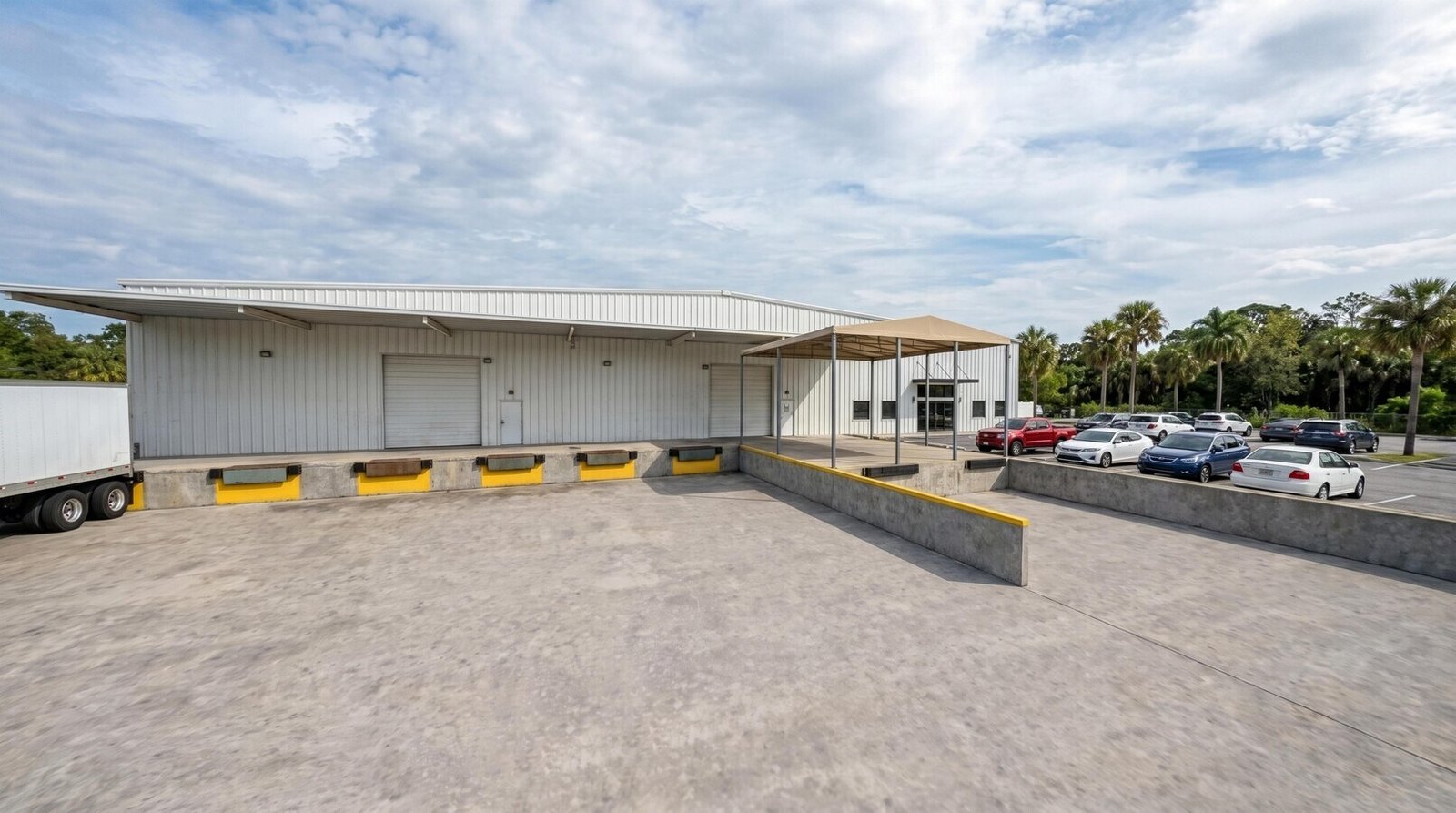
Trailer landing gear punches a small footprint into a lot of pavement. When a loaded trailer is parked at a dock and the tractor unhitches, thousands of pounds sit on two steel pads the size of dinner plates. Asphalt that is perfectly fine for cars will rut under that load within a season, and the repair means closing the dock to fix it. The truck court is the part of an industrial site that takes the most abuse and gets the least attention in early budgets.
We build truck courts and dock aprons for warehouses, distribution centers, plants for manufacturers and cross-dock terminals. The usual answer is heavy-duty reinforced concrete, designed for the trailer pads and the turning wheels, with joints placed to match the dock layout and drainage designed to keep water away from the doors. For some sites and some budgets, a combination of concrete aprons and asphalt drive lanes makes sense, and we help owners weigh it.
What follows describes the market we work in, the scope, the specifications that matter, and the cost choices behind them.
Freight corridors that put trucks on the lot
The metro has a strong freight base. The Tulsa Port of Catoosa is described by its operator as a 2,000-acre industrial park with more than 50 companies at the head of navigation on the Arkansas River system, and a short-line railroad there operates 20 miles of track with interchanges to three Class I railroads. Barges, rail cars and trucks all meet in the same area, and the trucking that moves goods onward ends up in truck courts. The Port of Catoosa area and nearby Catoosa are natural places for new dock and apron work.
Further northeast, Claremore's certified industrial park reaches 225 acres with access to Interstate 44, two state highways, the Will Rogers Turnpike and two railroads, according to a published business overview. In Broken Arrow, the Creek Turnpike and Highway 51 corridors feed the light industrial parks and business parks that need smaller but still heavy court areas. The shared pattern is easy highway access, which means many trucks and demanding pavement.
What we build around the building
A typical package includes subgrade preparation, a stabilized base, reinforced concrete paving of the dock approach, the full width of the truck maneuvering area, and the trailer parking positions along the building face. We form dock pits and leveler pits, set embedded steel, install drains and trench drains, and pour the dock-face walls with bumpers and bollards in place. Where an owner chooses a mixed system, we build the concrete apron to the specified depth from the dock and transition to asphalt in the lower-traffic lanes.
The details decide how it ages. Doweled joints keep slabs from stepping at the trailer wheel path. Sealed joints keep water and fines out. Slopes pull water away from the dock doors, since a ponded approach is a safety issue in winter and a dock leveler problem year round. The apron also has to meet the interior slab cleanly, which is why we coordinate this work with commercial concrete floors and not as a separate trade.
Design loads and local review
Pavement thickness is a function of expected truck counts, axle weights, subgrade strength and the design life the owner wants. The civil or geotechnical engineer sets it, and we build to it. We do raise the question of future use, because a building leased today to a light tenant may host a heavier user in ten years, and adding thickness at construction is much cheaper than adding it later.
Most municipalities review truck court plans for turning radii, driveway widths, screening and stormwater. The edition of the building code that governs the project also matters for fire department access around the building. With the statewide commercial code now at the 2024 International Building Code and Fire Code as of September 14, 2026, we confirm the fire lane and access dimensions with the local fire marshal early, because truck courts usually double as the fire apparatus route.
Concrete or asphalt, and how thick
Concrete costs more per square foot than asphalt at installation but usually lasts longer under static, concentrated loads. For a distribution operation with constant trailer drop, concrete is almost always the better lifecycle choice at the dock. For a long perimeter drive lane with only moving traffic, asphalt may do the job at a lower cost. We prepare both options with life-cycle numbers so owners can decide with the facts in front of them.
Other price drivers include the size of the court, which grows with trailer length and the number of doors; the number and size of drainage structures; the amount of dowel and rebar steel; and the subgrade preparation needed. A cross-dock truck terminal with doors on both sides needs two courts. A cold storage facility may need a heavier slab at the dock to resist the thermal cycling of frequent door openings.
Sequencing around live trucks
Truck courts are often built while the adjacent building is operating, or while deliveries to the construction site are underway. We separate construction traffic from visitor and truck traffic, stage pours so one side of the court stays open, and install temporary markings and barricades. Flaggers work alongside the superintendent to keep drivers off the fresh concrete.
Curing time affects planning. A concrete apron cannot see heavy trailer traffic for several days after the pour, so we plan the pour sequence to keep at least one dock approach open. For clients planning a distribution center that will open on a firm date, we work back from the first truck-in date and set the paving schedule accordingly.
Start with the trailers
Tell us how many doors, what trailers and how many per day. We will draft a court layout, a pavement option and a schedule to match your building.
Common Questions
Is concrete always needed at the dock?
Not always, but it is the safer choice where trailers will be parked and unhitched. Landing gear loads can rut asphalt in warm weather. If the tenant uses live unloading and drivers stay with their trucks, asphalt may be adequate. We recommend concrete at least in the dock approach.
How deep should the concrete be?
Seven to nine inches is common for heavy truck aprons, but the engineer sets the number based on traffic and subgrade. We follow the design and flag any concerns before the pour.
How wide does the court need to be?
A common design is 130 to 185 feet from dock face to the far edge for full-size trailers, depending on parking and turning. Local fire access and city rules may add requirements. We review the layout with the owner and the civil engineer.
What is the schedule for a typical dock apron?
Subgrade and base take a week or two on a mid-sized building, with the paving following in sequenced pours. Cure time before heavy traffic is typically seven days or more. Weather decides the rest.
Can you add truck court capacity to an existing building?
Yes. Expansion usually involves removing part of the existing pavement, extending the base and slab, and tying joints to the old pavement. We work in phases so operations can continue.
How do you keep the court from holding water?
We set slopes to pull runoff away from the dock doors and toward inlets or trench drains, usually in the range of one percent or a little more. We shoot grades before and after the pour and walk the court after the first rain. Birdbaths show up fast on a truck court, and fixing them in fresh concrete is far easier than grinding later.