A closed ramp can change where a truck terminal wants to sit. As of an Oklahoma Turnpike Authority advisory dated November 2, 2026, Creek Turnpike traffic between US-64 and East 111th Street runs one lane each way on a new Haikey Creek bridge, with delays expected through summer 2027, and the eastbound on-ramp from 96th Street is closed through fall. Across the river, the Oklahoma Department of Transportation lists an I-44 and US-75 interchange project in Tulsa continuing through summer 2028. A terminal operator who cannot get trucks in and out on time loses the one thing a terminal sells.
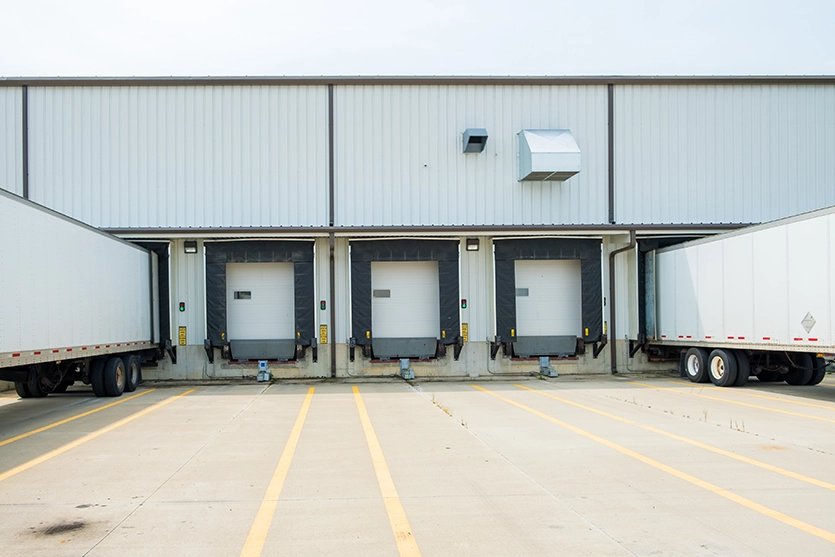
That is why we treat a truck terminal or cross-dock as a traffic project first and a building project second. The building is long and narrow, with doors on one or both sides, a thick concrete court that takes brutal loads, and very little interior to speak of. The value is in the geometry: how many doors, how they are spaced, how deep the court is and how trucks queue before they get to the doors.
We build cross-dock and less-than-truckload terminals, shuttle yards and trailer-swap facilities for operators and developers in the Tulsa metro, working closely with the traffic engineer, the city and the neighbors to make the layout work.
Doors, court depth and trailer flow
The single most important dimension on a cross-dock is the court depth. A 130-foot truck court allows trucks to back into doors and still leaves room for a parked trailer line. Deeper courts allow more trailer storage and more flexible maneuvering, at the expense of more land and more concrete. Dock door spacing of 12 to 14 feet on center is common, but depends on the freight and the forklift fleet.
Narrow buildings, often 100 to 150 feet wide, need a rigorous plan for sprinklers, lighting, dock equipment, wall protection and floor flatness. We lay out the building and court in a single set of drawings because column spacing, door count and trailer positions affect each other. Owners who also handle storage in addition to cross-docking should look at our distribution center page, and small-parcel operators may be closer to a logistics and fulfillment center.
The concrete court is the building
A truck court sees concentrated loads from loaded landing gear, braking and turning trailers, and the failure modes are punch-through at the gear, joint spalling and sagging. The usual answer is a thick, doweled concrete section over a stabilized subgrade with a drainage plan that keeps water away from the base. Reinforcement, joint spacing and sealants are all detailed, and the concrete is placed in a sequence that matches the dock wall schedule. Our truck court and dock apron service handles these pours.
The dock wall itself needs steel bumpers, leveler pits and seals or shelters at every door. For a terminal that runs at night, lighting and security are part of the package, and so are the canopy and the pits' drainage. We coordinate those details with the dock equipment supplier before the wall is poured.
Site work that carries traffic
A truck terminal has a lot of site. Roads that handle heavy trucks day and night, a queue lane that holds vehicles without backing onto a public street, stormwater detention that works for acres of paving, truck wash or fuel areas if the operator wants them, and fencing and gates that control entry. We take responsibility for grading, utilities, paving and detention under our site development and utilities scope so the site comes together on one schedule.
We also plan for the temporary traffic that a terminal project generates. Concrete trucks, aggregate haulers and cranes need to enter and leave without conflict, and the roads leading to the site may be busy with other work. We communicate with neighbors and city staff about haul routes and hours before we mobilize.
Where terminals work in this metro
Broken Arrow's two main arteries tell much of the story. Wikipedia describes State Highway 51, the Broken Arrow Expressway, as running through the north side of the city and leading to downtown Tulsa, and the Creek Turnpike as running along the south side and linking the Turner Turnpike with the Will Rogers Turnpike. KRMG reported in May 2026 that the city's Reconnecting Broken Arrow project, funded in part by a federal RAISE grant, identifies the Elm Place and Lynn Lane interchanges as congestion points, with design finishing in 2027 and construction an estimated five to eight years away at best. That is a signal for terminal developers: choose sites with direct turnpike access over sites that rely on the expressway interchanges.
Elsewhere in the metro, Catoosa's I-44 and SH-66 interchange improvement continues through early 2027, and the Creek Turnpike branches east from I-44 in Sapulpa, giving a western approach to the same loop. Our pages on the Creek Turnpike corridor and the Broken Arrow Expressway corridor discuss those routes in more depth.
Building and operating around the freight network
Terminal owners often come to us with a site and a question about permits, so we start with permitting and entitlements. Traffic studies, driveway permits on state routes, stormwater permits and fire department review of truck courts are the common items. We keep a calendar of those approvals and tie them to the construction schedule.
Terminal operations also appear in our work with logistics and distribution companies, which tend to value predictable schedules and quick turnover from groundbreaking to first load. We design the first phase to be operational as soon as safely possible while later phases continue.
Planning a terminal or cross-dock?
Send us your door count, trailer plan and target sites, and we will test the court layout, the permits and the schedule with you.
Common Questions
How deep should a truck court be?
Many cross-docks use a court of about 130 feet to allow backing and a line of parked trailers, but the right depth depends on the trailer type, the door count and your operating pattern. We test the layout with truck-turning templates before committing to land.
Can I put a terminal near a highway ramp that is under construction?
You can, but ask the Oklahoma Department of Transportation or the Oklahoma Turnpike Authority for the schedule of the project and for the timing of ramp openings. Closures and lane shifts can add delay to every truck, and the plan for the first year of operations should account for them.
What drives the cost of a cross-dock?
Concrete, because the court is thick and extensive. Beyond that, door count and dock equipment, the fire protection design, site detention and lighting. Land that is flat and already has utilities saves real money.
How long does construction take?
A cross-dock building is simple, so the long poles are the permitting and the court paving. Once the site is ready, the building itself moves quickly. We schedule the court so the concrete cures before trucks are allowed on it.
Do I need a traffic study?
Probably, if the terminal will generate enough trips to affect nearby roads or if it connects to a state route. Even where a study is not required, we recommend one, because the way trucks queue and turn affects both safety and neighbors.